|
| Our group loved Florence. |
 |
| Florence is stunning in the daytime and at night, in the sun and in the rain. |
On February 27, I headed to Florence for three days as a supervisor on a school trip. I had visited the city twice previously, but I was eager to return. Who wouldn't want to spend time in a place that was the centre of the Renaissance?
 |
| A view from the Uffizi towards the Duomo. |
When Lyn, our school travel organizer, sets up a trip, she brings years of experience to the planning. She knows how to maximize our time in each location, combining educational opportunities with free time, and reserving for us dinners in good restaurants, as well as highly recommended guides to help us understand the history and culture of the city.
 |
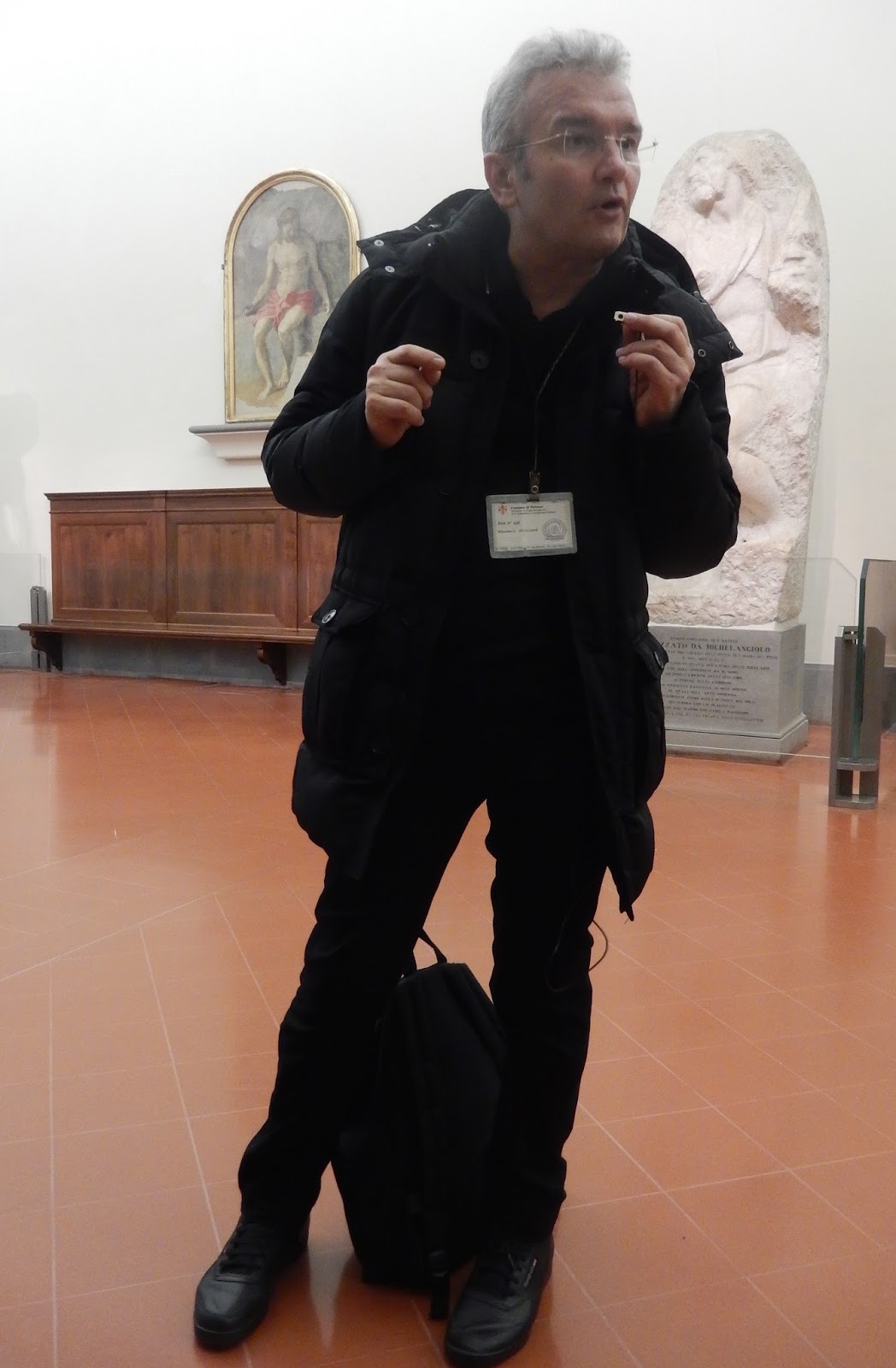
| Elvio |
In Florence, Lyn always books Elvio and Roberto, two men who have been favourites with our students and staff for several years. For two days, I saw Florence through the eyes of Elvio since I was assigned to his group. What a charming and intelligent man he is!
 |
| Part of the Uffizi |
 |
| Michelangelo's Doni Tondo |
On Sunday, he met us at our hotel and led us to the Uffizi Gallery where for the next two hours, we learned about art history, his passion. We learned what to look for in order to understand the revolution that was the Renaissance; we came to appreciate the genius of the great masters; and we became educated on the patterns and techniques of great art.
 |
| The better Boticelli? |
While Boticelli's Venus is an outstanding and very famous work, after listening to Elvio, I found myself more drawn to his favourite piece by the artist, "Primavera". I agree with him, there is much to admire about this charming painting.
 |
| David's expression. |
 |
| Elvio captivates our students with his knowledge of the city. |
Moving on to the Academia, Elvio walked us around Michelangelo's David, insisting that we view the sculpture from all angles. This way we came to understand the sculptor's genius, as he sought to create this unique work.
 |
| Some of the statues in the loggia. |
 |
| Elvio and the students inside the loggia. |
The next day, Elvio led us on a walking tour around the city. The emphasis was on several great churches, although our first stop was the Loggia dei Lanzi on a corner of the Piazza della Signoria. This open-air sculpture gallery was built in the 14th Century, and contains works from several subsequent centuries, including the famous Rape of the Sabine Women by Giambologna. It is remarkable that so much beautiful art sits in an outdoor space.
 |
| Inside the first courtyard. |
Inside the nearby Signoria (also known as the Palazzo Vecchio) are more wonders. We visited the first courtyard, a beautiful space with frescoes on the walls, ornate columns, and vaulted ceilings, all designed to please the Medici family.
 |
| Elvio takes advantage of a break in the rain to highlight the sights in the piazza. |
Outside, the large Piazza has been a popular gathering place for centuries. On this rainy day, it was quite deserted, but that did not prevent us from admiring the beautiful Neptune fountain in front of the Signoria.
 |
| The tabernacle at Orsanmichele. |
 |
| Sculptures in the Orsanmichele Museum |
Elvio's enthusiasm for his city was never more obvious than when he interrupted our planned tour for a brief visit to Orsanmichele, the church of the guilds. Its upper gallery is only open on Mondays, the day of our walk, so our guide took advantage of this happy coincidence. Here we learned about the statues each guild commissioned of its patron saint. These were once housed outside in niches, but now the exterior works are replicas. Famous Florentines such as Donatello and Ghiberti created these beautiful sculptures.
 |
| Mary waves at us on the façade of the Duomo. |
Our next stop was the massive Duomo. It took 140 years to build this magnificent church. Although, I had already wandered around the interior earlier during our stay, seeing it through Elvio's eyes brought so much more to the experience. Brunelleschi's Dome is a masterpiece, not to be missed. We craned our necks to admire the Vasari's fresco inside it. Wow!!
 |
| Looking up inside the dome. |
 |
| The clock. |
Another notable feature of the interior of the Duomo is the 24-hour clock, from the 14th Century. Until the 18th Century, Florentines kept time this way.
 |
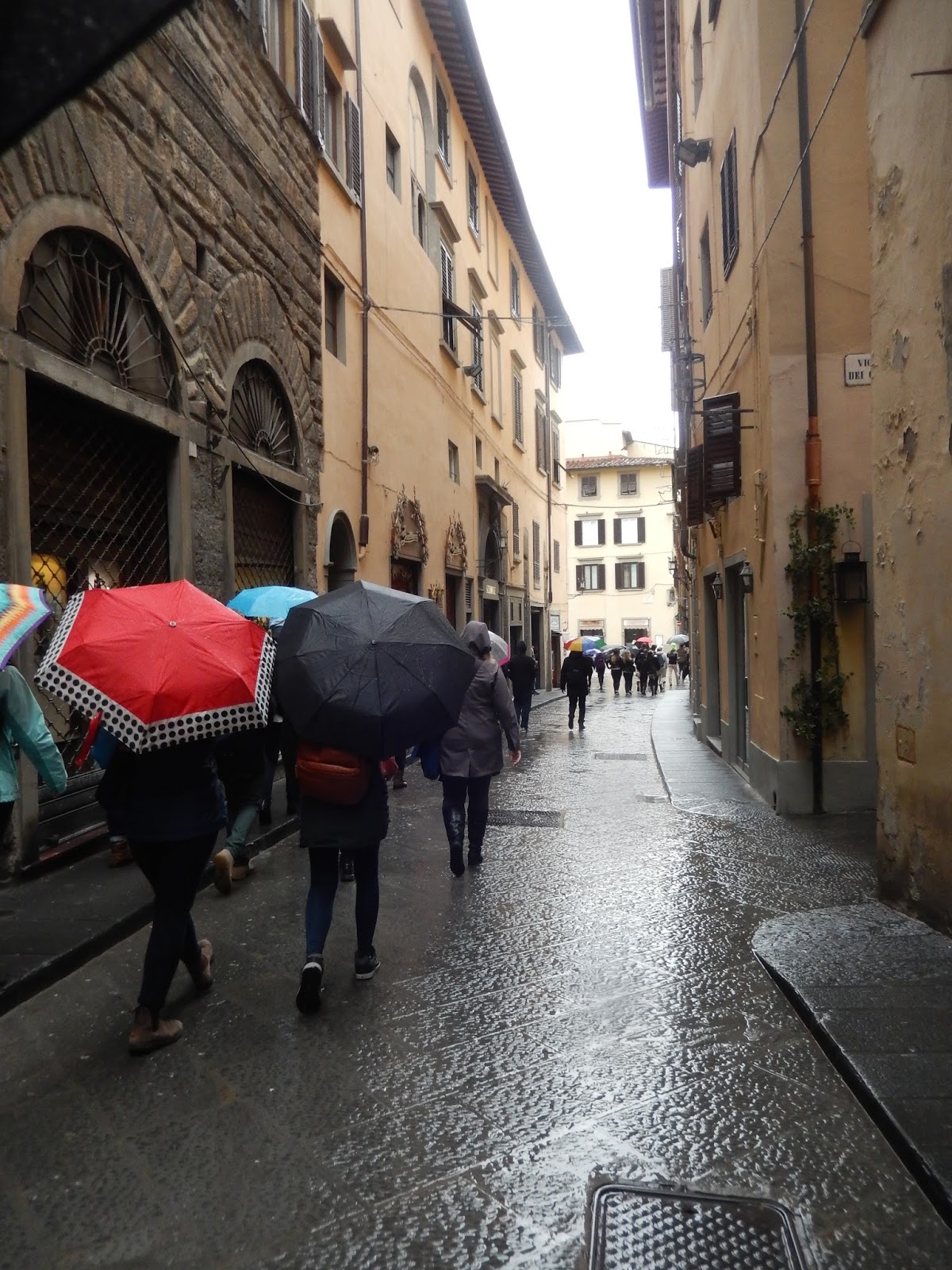
| Walking in the rain. |
 |
| Michelangelo is buried here. |
 |
| Galileo's funerary monument |
From the Duomo, we made our way along Florence's winding streets to its other major church, the Basilica of Santa Croce, the largest Franciscan church in the world. Here lie the funerary monuments of notable Florentines, such as Machiavelli, Galileo, and Michelangelo, all giants in their fields. The Basilica also houses a beautiful cloister and an old refectory where the first known fresco of the Last Supper is depicted.
 |
| A chapel inside the Basilica |
 |
| The Last Supper in the refectory |
When we emerged from the Basilica, the sun greeted us–for a few minutes. The photo below is the only one I have with some blue sky in it.
 |
| Blue sky over Santa Croce |
Yes, Florence was grey when we were there, and there was lots and lots of rain, but we enjoyed the city greatly anyway. When we were not on tour with Elvio, we explored on our own.
 |
| Inside the Museum |
 |
| Lorenzo Ghiberti's Baptistry doors |
For 15 Euros, we bought a combination ticket to the Duomo's five attractions. The newest of these, the Museo dell'Opera del Duomo, is stunning. Here, Jen and I saw art pieces that have been moved from the church to preserve them. Among these are the golden doors of the Baptistry, as well as a pieta by Michelangelo, and a silver and enamelled altar of St. John the Baptist.
 |
| A stunning altar |
 |
| Mosaic floor in the crypt |
We also visited the crypt of the church, where mosaic floors suggest an early Roman presence in the area. Finally, we entered the baptistry, a small but spectacular building. Here, as in the Duomo, the ceiling is the highlight.
 |
| The ceiling of the Baptistry |
While we were exploring at ground level, Adam, Kezia and Jen's son, Jacob, climbed to the top of the Duomo, and afterwards, the Campanile, the bell tower. That made over 900 steps to climb. Good for them!
 |
| Jacob's photo from the top of the Duomo. |
Our time in the city was not all art and architecture, however. We enjoyed the food and shopping too. After all, we were in Tuscany, the garden of Italy, and in Florence, the home of some of the best leather in Europe.
 |
| Ham cures on the ceiling of the restaurant... |
 |
| ...to be eventually sliced into delicious prosciutto. |
 |
| Some of our group in the middle of the feast |
Lyn had made arrangements with two restaurants to accommodate all thirty-six of us. On our first night in the city, we ate at Il Latini, a restaurant where the bounty of the area was fully apparent. Housed in a room on our own, we began the meal with several antipasti, followed by a pasta course, then a large platter of meat, then accompanying vegetables, then an aperitif with biscotti, and then a variety of desserts. The food was very good, but there was just too much of it for me!
 |
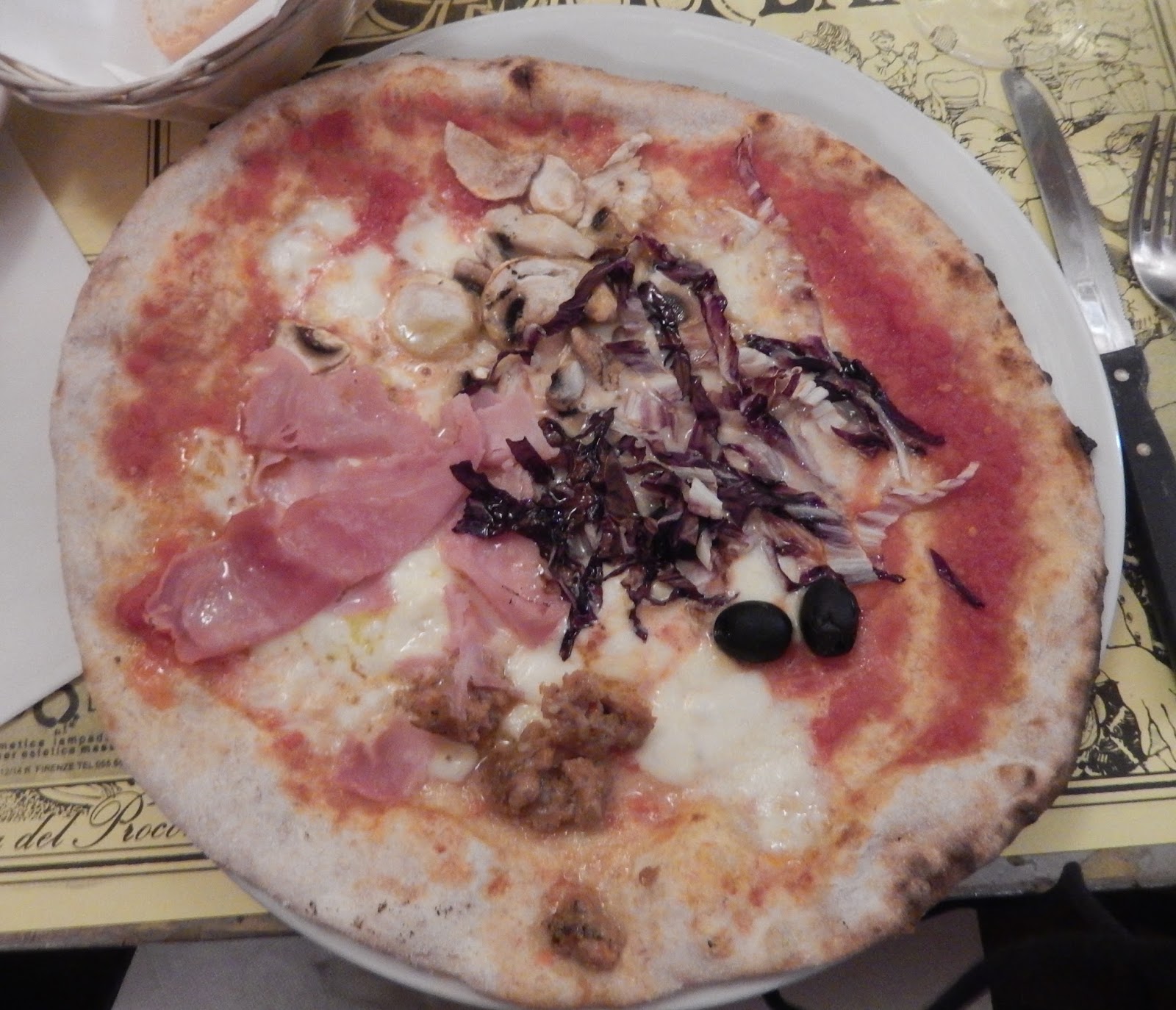
| My pizza at the Yellow Bar |
 |
| Happy faces at the Yellow Bar. |
On our second night, we dined at the Yellow Bar, where Elvio, our guide, moonlights as the Maitre D' on weekends. Again, we were seated in a room on our own, but this time, we ate à la carte, so we could exercise restraint if we chose. Of course, Elvio made sure we had good service and he treated the teachers to a limoncello as an apéritif after the meal.
 |
| Trying geeato |
Between Florentine feasts, we found many other places to please our palates. Gelato was a favourite with both students and staff, of course. When we sought out the best place in town, according to our guides, we ran into a group of our students.
 |
| Beth poses in front of Perche No! - the home of the best gelato |
 |
| Beth, Kezia and Adam in the Boar leather market. |
We saw many of the students in the leather markets as well. Over the course of our three days in Florence, we contributed a great deal to the local economy. It seems as if everyone left the city with a belt, a wallet, a bag, or a jacket–all made from the finest leather, or so we were assured.
 |
| Chloe and Alex feeling the love of Florence. |
Our three days in Florence fuelled my spirit, The students loved the city and absorbed a great deal of its culture, even as they dodged rain much of the time. Below, I have attached the address of the blog of the trip we took there last year if you want to see what the city looks like when the sun shines. It will show you even more of Florence's beauty.
http://livingmydreaminbeautifulswitzerland.blogspot.ch/2015/03/unofficially-in-florence.html